


The things people collect and keep say a great deal about who they are — but how those things are stored and displayed shapes whether they stay meaningful or quietly deteriorate. A poorly lit shelf can fade a vintage poster within months. A humid basement can warp a stack of first-edition paperbacks in a single season.
The challenge isn’t just finding a place to put things; it’s deciding which items deserve to be seen, which need protection, and how to build a system that holds up as a collection grows or changes over time.
Protecting What You Display From Everyday Damage
Most display damage doesn’t happen in a single event. It accumulates slowly — UV exposure bleaching colors, humidity warping materials, dust abrading delicate surfaces. Understanding which threat is most relevant to a given item determines which protection method actually matters.
For paper items, photographs, and printed artwork, UV-filtering glass or acrylic is the most effective single upgrade a person can make. Standard picture-frame glass blocks almost no ultraviolet radiation. Museum-quality UV-filtering acrylic, which runs roughly $15 to $40 per square foot depending on thickness, can block up to 99% of UV rays without the reflective glare that makes standard glass difficult to view.
Humidity is a slower and often invisible threat. Wood expands and contracts with moisture changes, which is why antique furniture joints loosen, and vintage instruments crack in centrally heated rooms. A room-level humidity of 45 to 55 percent relative humidity is widely recommended for mixed collections. Small, rechargeable silica gel canisters placed inside closed display cases cost under $10 each and significantly reduce moisture fluctuation.
Temperature is the third factor that’s frequently underestimated. Attics and garages swing between extremes that even durable materials can’t handle indefinitely. A climate-controlled interior room — ideally maintaining a consistent 65 to 70 degrees Fahrenheit — is the right environment for anything irreplaceable.
Choosing Between Open Display and Enclosed Storage
The choice between displaying items openly and storing them in enclosed cases is partly aesthetic and partly a long-term preservation decision. Open shelves create a living, accessible feel — but they also expose items to dust, accidental contact, and ambient light. Enclosed cases reduce all three risks substantially but change the visual character of a space.
For everyday decorative objects with no significant fragility or monetary value, open display is entirely practical. For anything with genuine fragility — hand-painted ceramics, taxidermy, antique textiles, or items with moving parts — enclosed storage isn’t optional if longevity matters. A sealed shadowbox, for example, dramatically reduces the rate at which insects and airborne oils damage organic materials.
The middle path many collectors settle on is a hybrid approach: display a rotating selection openly while keeping the broader collection stored properly. This works particularly well for items that share a common format, like vintage watches or small sculptural pieces, where displaying three or four at a time keeps the space visually intentional rather than overwhelming. Rotating items every three to six months also reduces cumulative light exposure for any single piece.
Cost matters here. A quality enclosed display cabinet with UV-filtering glass starts around $200 and can exceed $1,000 for custom work. Open shelving, by contrast, can be assembled for under $50. The trade-off is real: the budget option accepts more risk, and the premium option requires a longer-term commitment to a particular display layout.
Organizing Collections That Grow Over Time
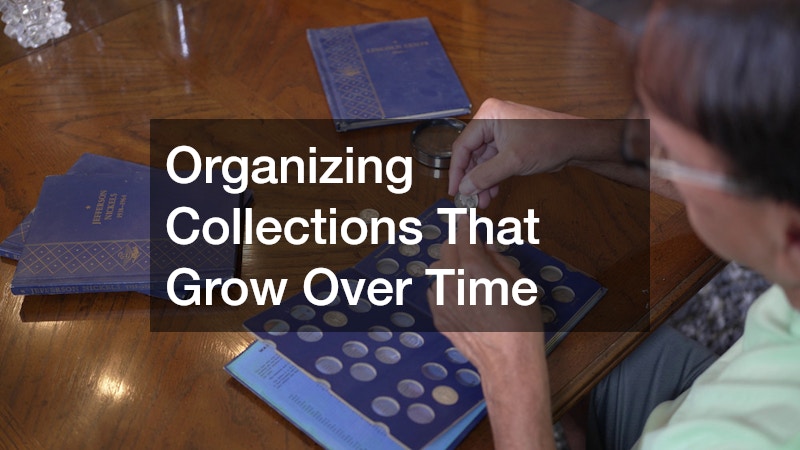
A collection that starts as a dozen items and grows to several hundred needs a system that scales — and most people don’t build one until the disorder is already a problem. The better approach is to establish a cataloging habit early, even before it feels necessary.
A simple spreadsheet tracking item name, acquisition date, condition, and approximate value is sufficient for most personal collections. For larger or more valuable collections, purpose-built collection management software — some free, some subscription-based at $5 to $15 per month — allows photo documentation and insurance-ready export formats. Insurance riders for collectibles typically require itemized documentation, so this step has practical financial consequences beyond simple organization.
Hobby-specific storage demands vary significantly. Coin collecting, for instance, involves flat storage in chemically inert holders or albums, with a strong preference for Mylar or polyethylene flips over PVC-based options, which leach chemicals over time. Sports cards require similar archival thinking. Vintage electronics need padding, anti-static materials, and careful attention to battery corrosion prevention. Each category has a known set of best practices that collectors in that space have tested over decades.
Labeling physical storage containers on the exterior — with enough detail to locate a specific item without opening every box — reduces handling frequency, which is itself a form of protection. The fewer times a fragile item is picked up unnecessarily, the longer it stays undamaged.
Making Display Feel Intentional Rather Than Cluttered
There’s a meaningful difference between a collection on display and a room full of stuff. The distinction usually comes down to editing, context, and negative space. When every surface is covered at the same visual density, the eye has nowhere to rest, and individual items lose impact regardless of their actual significance.
Grouping by a single consistent variable — material, color family, era, or scale — creates visual coherence without requiring expensive furniture or renovation. A shelf of objects that are all white or cream, for example, reads as curated even if the individual pieces have no thematic connection. Varying the height within a group by using small risers or stacked books adds dimension without crowding.
Lighting deserves more attention than most people give it. Recessed LED strip lighting inside a display case, or a small directional picture light mounted above a framed piece, costs $20 to $80 and transforms how an item reads in a room. Warm-white LEDs in the 2700 to 3000 Kelvin range render color accurately for most decorative items without the harshness of cooler daylight temperatures.
The hardest editing decision is usually what to put away entirely. Not every acquired item deserves permanent display. Rotating stored items into view seasonally, or as context shifts, keeps a display feeling alive without expanding it indefinitely.
Building a Storage and Display System That Lasts
The practical goal is a setup that doesn’t require constant intervention — where protection is built in, organization is easy to maintain, and the display itself evolves without falling apart. That means investing in archival-quality materials the first time rather than replacing cheaper options every few years.
Start with the most vulnerable items and work outward. Identify what is truly irreplaceable, secure it in appropriate enclosed storage with documented condition records, and build the open display layer around what can tolerate more exposure. Revisit the system annually — not to overhaul it, but to check for signs of environmental damage, update the inventory, and decide whether the current display still reflects what the collection has become.