

Snow is, objectively, frozen precipitation. It slows traffic, strains rooftops, and complicates travel. Yet across the world, the same snowfall that one community shovels away becomes the raw material for festivals, rituals, and communal gatherings that define an entire season. The gap between inconvenience and celebration has everything to do with cultural framing — how a society decides, over generations, to interpret winter’s arrival. Understanding these traditions doesn’t just satisfy curiosity. It reveals how climate shapes identity, and why winter celebrations look so radically different depending on where you stand.
When Snow Becomes Architecture — Japan’s Yuki Matsuri and Scandinavian Ice Culture
Japan’s Sapporo Snow Festival, held each February, offers one of the clearest examples of snow treated as a serious artistic medium. Teams spend weeks constructing elaborate ice sculptures and massive snow structures — some exceeding 50 feet in height — that are illuminated at night and viewed by millions over a single week. The festival began in 1950 as a small event organized by local high school students, which makes its current scale remarkable: it draws roughly 2 million visitors annually, generating significant regional economic activity during what would otherwise be a slow tourism period.
Scandinavia takes a different architectural approach. Sweden’s Icehotel, reconstructed from scratch each winter using ice harvested from the Torne River, frames frozen water not as festival decoration but as functional space — rooms, bars, and art galleries that exist only until spring melt. The comparison matters because these two traditions represent distinct philosophies: one celebrates snow as communal spectacle, the other transforms it into intimate, temporary shelter.
For anyone interested in experiencing either type of tradition, timing is the critical variable. Sapporo’s main festival runs for about a week in early February, while the Swedish Icehotel accepts guests from December through April. Arriving outside those windows means missing the structures entirely.
Indigenous and Pre-Industrial Traditions — Celebrating Snow Before It Was Optional
Many of the world’s oldest winter snow traditions emerged not from leisure but from survival. For numerous Arctic Indigenous communities — including Inuit groups across Canada, Alaska, and Greenland — snow wasn’t scenery. It was insulation, building material, and a navigational marker. Celebrations tied to winter weren’t about enjoying the cold; they marked the successful adaptation to it.
Inuit midwinter gatherings traditionally combined practical knowledge-sharing with storytelling, drumming, and communal feasting. Snow itself figured into games and competitions that trained physical skills relevant to arctic survival, including endurance and agility challenges conducted in deep cold. These weren’t recreational additions to daily life — they were how communities maintained cohesion through months of isolation and darkness.
The contrast with modern commercial winter festivals is stark. Today, families visiting outdoor winter markets in many parts of the US might pay $15 for a hot chocolate while browsing vendor stalls. That experience is pleasant, but it operates in a completely different register than celebrations built around genuine dependence on snow and ice. Neither is superior — they serve different social functions — but conflating them strips the older traditions of their actual weight.
Anthropologists studying Indigenous winter practices have consistently emphasized that these traditions encode environmental knowledge: understanding snow types, reading ice stability, predicting weather from observable patterns. That knowledge layer is absent from most contemporary snow festivals, which is worth acknowledging when cultures borrow or adapt these celebrations.
European Carnival and Pre-Lenten Snow Culture — The Threshold Between Winter and Spring
Across much of central and eastern Europe, the most elaborate winter celebrations don’t treat snow as the point — they treat it as the backdrop for rituals marking winter’s eventual end. Fasching in German-speaking regions, Maslenitsa in Russia and parts of Eastern Europe, and related carnival traditions elsewhere all cluster in late winter, often tied to the Christian liturgical calendar but drawing on much older seasonal customs.
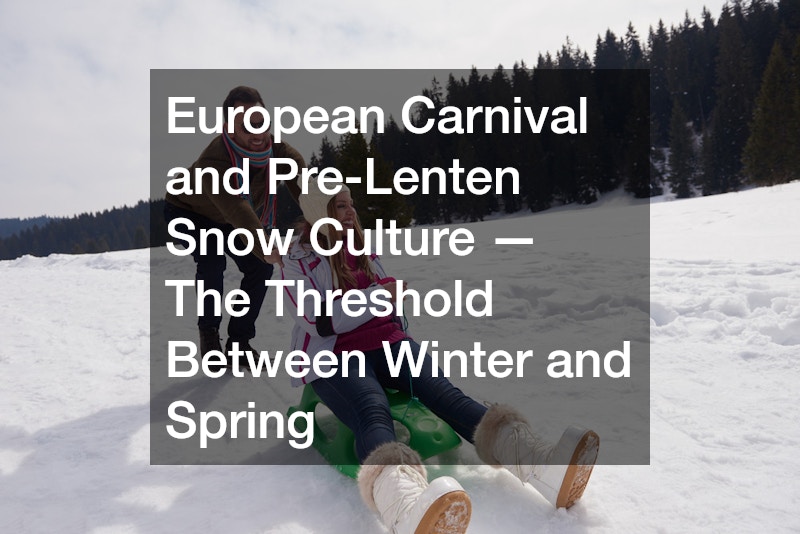
Maslenitsa is particularly instructive. The week-long celebration involves pancake feasting, outdoor games, communal sledding on purpose-built hills, and the ceremonial burning of a straw effigy representing winter. The sledding component is significant: historically, the quality of the sled run was thought to predict the summer harvest, which meant that snow sled rentals weren’t just recreational gear but objects embedded in community ritual and agricultural anxiety.
The European carnival tradition more broadly uses winter’s final weeks as permission for social inversion — masks, costumes, and behavior that ordinary social norms would prohibit. Snow provides the atmospheric setting, but the real engine is the psychological need to release tension before the austerity of Lent or the hard work of spring planting.
What distinguishes these traditions from purely recreational snow culture is the element of transition. The celebration isn’t about winter itself; it’s about standing at its edge. That framing explains why the rituals are often deliberately rowdy or excessive — excess before scarcity is a recurring human pattern across cultures and centuries.
Modern Snow Festivals and the Question of Authenticity
Contemporary snow festivals in the US — ice sculpture competitions, winter carnivals, ski resort events — borrow visual elements from older traditions while operating under entirely different conditions. Admission fees, corporate sponsorships, and curated experiences replace the communal, necessity-driven character of older winter celebrations. That’s not inherently a problem, but it does raise a genuine question about what these events actually transmit.
The more useful comparison is between two types of modern winter engagement: passive spectatorship versus active participation. Watching an ice sculpture competition from behind a barrier delivers aesthetic pleasure but no skill, no community obligation, and no personal risk. Joining a neighborhood snow-sculpting competition, participating in a traditional outdoor winter game, or learning the cold-weather crafts associated with a specific cultural tradition produces a fundamentally different experience — one closer to what older winter celebrations actually provided.
Families navigating this distinction have real options. Many regional winter festivals specifically program participatory elements: snowshoe demonstrations, ice fishing introductions, traditional craft workshops. Seeking those components out, rather than treating the festival as a viewing event, shifts the experience closer to what made winter celebrations meaningful in the first place.
Cultural borrowing in winter traditions also deserves attention. When elements of Maslenitsa, Yuki Matsuri, or Indigenous winter games appear in commercial festival programming, the depth of context those traditions carry rarely travels with them. Attending a pancake breakfast billed as “Maslenitsa-inspired” without knowing what the original celebration meant leaves participants with aesthetics but not understanding.
Finding the Thread That Runs Through All of Them
What survives across all of these traditions — Japanese snow sculpture, Inuit midwinter gathering, European carnival, modern festival — is the refusal to treat winter as purely a problem to endure. Each culture found a different answer to the same question: if snow is inevitable, what do we build with it?
The practical takeaway for anyone drawn to winter celebrations is to approach them with more context than a schedule and a parking plan. Research the origin of what you’re attending. Look for the participatory layer beneath the spectacle. If a tradition has Indigenous roots, find out whether the community itself is involved in presenting it. Winter celebrations reward the extra attention — they tend to carry more meaning than their surface appearance suggests, and that meaning is exactly what makes them worth seeking out across cultural lines.
